An exemplar of civil disagreement in practice
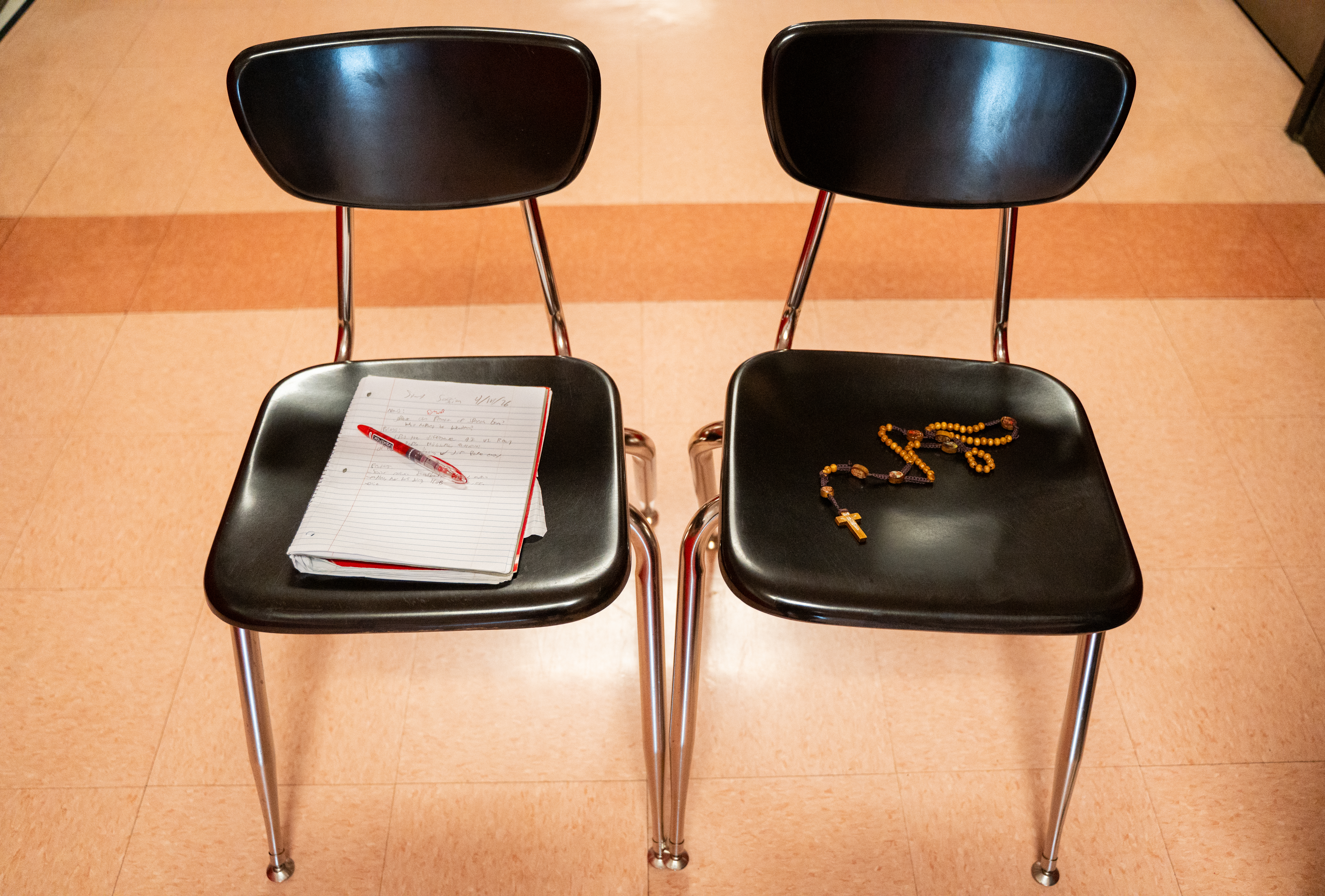
Discussing religion in a cordial manner has become more difficult due to increased polarization. Photo courtesy of Zach Carter.
Religion (along with politics) is one of the things we are told never to discuss openly or with people we don’t know. Not at the dinner table, not with new people, not at school. And for good reason, as religion is a hugely divisive topic that only seems to grow in hostility, creating long-lasting barriers among followers and non-followers. But what if we could learn to have respectful, eye-opening dialogue about faith? The conversation below will attempt to do just that.
But how can we conduct ourselves in a respectful manner while still holding firm to our beliefs? With active listening, intellectual humility, curiosity, and empathy to understand, the balance between belief and hostility can be managed, according to Interfaith Philadelphia. Naturally, we also suffer from the condition of inadvertently seeking conversion in our counterparts. That's why the temptation to create a “debate atmosphere” often breeds negativity. At the same time, we shouldn’t be afraid to ask our genuine and sometimes difficult questions: real curiosity is the spark for new understanding.
So, with these tools in mind, Steven, a critical agnostic, and Joe, a firm Catholic, sat down during their SCO period to attempt to exemplify how to conduct a respectful religious dialogue. Below are some of the discussion questions we posed to each other and a shortened version of our conversation.
What is your stance on religion in contemporary society?
Joe: I think that overall, religion is being left behind because of the rationalist and scientific movements that are good, in some sense, but they also leave a lot of people searching for meaning. And I think they lead a lot of people into places where they're, you know, depressed or lacking meaning. I think religion is kind of decreasing overall in contemporary society, and I think people often forget its value.
Steven: In my opinion, I think over time, people have started to become discontent with religion as a whole, because a lot of its practitioners are pretty overbearing with the rules and regulations. And often, people think it's a direct contradiction with their own worldview on topics like abortion and women's rights. I agree with you that religion is being eroded, but I think a direct consequence of that is that the people who are sticking with religion are becoming very extremist in their views. The far-right believers, for example, are starting to conflate religion in their justifications for why they believe what they believe, separating people from it even more. They have a right to do that, but I still think it creates a lot of negativity with the social practices it produces.
Joe: Well, if you say that, then you must remember that the contrast of radical versus rational thinking has been happening for a long time. You can go back all the way to the offshoots of Protestantism, or a lot of the early radical offshoots of Islam, like the Mu’tazila. It's a common phenomenon that, you know, some groups go to the side, and they become really radical, but we can’t define the entire religion based on those people.
Steven: People trying to strictly define religion is the exact reason why many people aren't following it right now. Over the years, Christianity was the dominant religion, and as a result, you had people all over the spectrum in terms of how much they believed. You would have people who just believe in God, but wouldn't go to their place of worship. You had people who were more socially progressive, but still went to their mosques or churches. But as religion has started to lose dominance, followers who would be a bit more modest with their faith started to reject traditionalist interpretations of religious texts. So when you say that there should be a narrow interpretation of what their religion actually means, I think that ostracizes people who struggle with accepting a particular doctrine full heartedly. It’s all too strict and rigid, I think.
Why can religion often be a force for inequality?
Steven: Another argument I have is that religion primarily serves the elite by promising the poor that a lot of the justification for why they're poor is a conscious decision by God to make them have a stronger connection with him. In Christianity, there is the concept that God puts his strongest soldiers on the most difficult path. I simply think those notions are inherently bad for society, because people stop interrogating why they're actually poor, and instead just toss it up to God, pushing them to accept their situation when it really shouldn't be that way. In reality, it is the very people who tell them these lies who are profiting from them. That's why they're poor, not because God deems it so. It leaves people stagnant and leads them not to question elitism.
Joe: That's an interesting point you make, and I’ve heard a lot of others make it. You forget, though, that the Catholic Church is the biggest charitable organization in the history of mankind. So I think they're doing quite the opposite of what you say. They're uplifting the poor, and they're allowing the poor to see themselves as valued, as no other society values them. And they're giving them the motivation and the hope that nothing else gives them. The whole point of Christianity is to love and serve the needy.
Steven: Yeah, I get that, but I'm coming from the position that it's a false sense of hope, because you're essentially just giving a dog a bone. That's how I feel. It's inherently coming from a position of Saviorism. The church is positioning itself as above poor people, and they're acting as the embodiment of God, and then they're providing all these things under the grace of God. I’m not saying it's an intentional method of keeping people stagnant, but it often does just that. It provides people with less urgency, allowing them to not care about the ongoing societal structures that actually made them poor. In the end, it just keeps them in their low-income positions. It's a top-down dynamic, where a religious entity is the savior.
Joe: Well, that makes sense, my friend, because we worship a savior. We worship someone who saved us and gave his life for us. I think you’re getting a little at the idea of ethical egoism, the idea that the church only does things to lift itself up. I think that's a dangerous way of looking at actions, because it discourages us from doing any good. I would also say that the church is poor, and the whole point of the church is to be as much like Christ as it can. And Christ, of course, was a servant to all, and he was as low and as poor as possible. So I think that it's quite the opposite in most ways.
Does secularism offer enough support in times of grief, or are people bound to follow religion?
Joe: I think this is an interesting thing, because I believe there’s no such thing as a real atheist. A real atheist would just not believe in anything, and, in the end, everyone believes in something. Everyone has faith in either their family, their goals, or how other people see them. And skepticism can provide a lot of answers to a lot of questions, but it can't answer the biggest questions, which are: Who created me? And, who am I? With those things you need to, as Kirkeegaard said, take “a leap of faith.” I think that's one problem with secularism. I don’t know, what do you think?
Steven: I think many people, depending on what religious enclave they live in, have been constantly imposed on by religion since childhood. If not through practice, then by the implementation of religious “values” in institutions. So I definitely believe that in the back of people's minds, whenever we face hardship, there's this weird inclination to default to reactionary questions on existentialism: Does this matter? Can I get through this? And religion does offer comfort to those questions, while a devout atheist or agnostic may find discomfort. So I can see how secularism doesn't provide enough. It lacks the assuredness that many religious people have. At the same time, though, it's not easy to just flip the switch and believe there is a divine being out there. Often, it's hard because there is a burden of proof. It's much harder to believe in a divine entity than in evolution. Overall, though, I think in small day-to-day matters, secularism can function without religion. With camaraderie, shared interests, and other things, it can definitely provide enough support. But in times of existential crisis, it's very hard to swallow those big existential problems. And this is just me speaking personally, but I can't understand how the idea of an afterlife fits into all this. Even in the hereafter, believing won’t necessarily mean that you're free of the pressure. With the afterlife in specific, I'm quick to question heaven and hell, because if there's an all-forgiving and all-loving God, then why segregate based on faith? It’s so harsh to let some people in and exclude everyone else.
Joe: I think it's the opposite. I think it's jarring that you can think that it was your choice in the first place to rebel against this creator who made you, and not feel responsible for that action. And I like to point out the Eastern Orthodox concept of the afterlife, which I think explains some of these questions more clearly. They basically think that if you go to heaven, you're gonna see God face to face, and you're gonna be overjoyed. However, if you go to hell, you're also gonna see God face to face, but to you, God will be only suffering and pain, because that's how you chose to see God your whole life. And I think that's kind of an interesting way of looking at it. Because, in the end, Heaven and Hell are our choice.
Steven: That’s a good point, I’ve never thought about the afterlife like that.
Joe: Thanks, Steven. I thought you made some really thought-provoking arguments, too. Thanks for talking with me, I hope you enjoyed this.
Steven: Yeah, I did! I’m glad we were able to talk about these things respectfully while still getting our points across.
Steven Dubon. TBD More »
Joe Newman. Hi, I'm Joe Newman. I'm a senior here at Blair and this is my second year on SCO. I play tennis, soccer, and I run cross-country. I'm also really into religion and philosophy, and I love having deep discussions with others. Oh, y no se … More »
No comments.
Please ensure that all comments are mature and responsible; they will go through moderation.