Day in and day out, the firefighters of Station 16 protect the buildings and citizens of Silver Spring
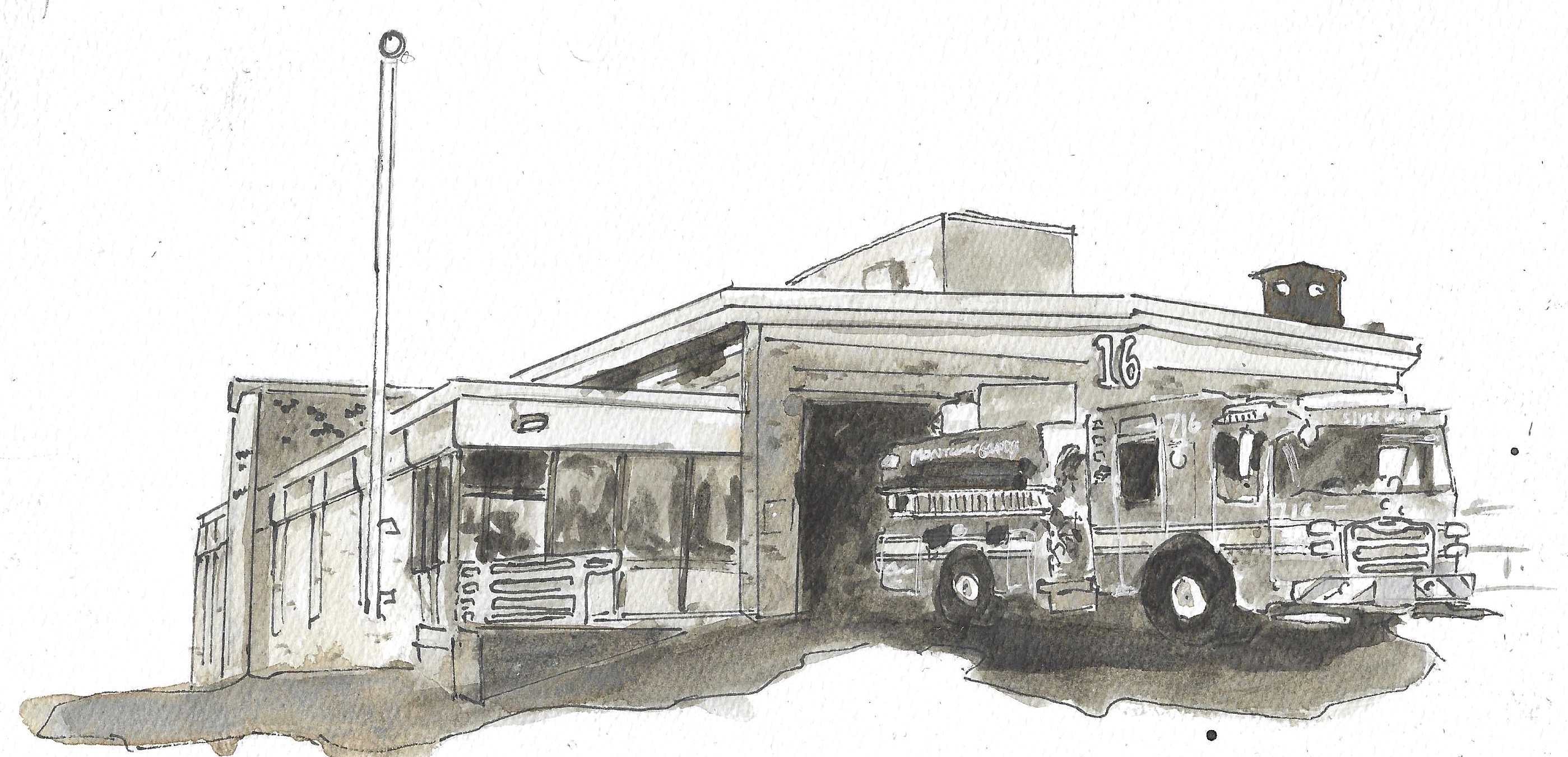
Silver Spring Fire Station 16, situtated next to Blair, has been around since 1947. Photo courtesy of Rosalind Merrill.
Since 1947, Silver Spring Fire Station 16 has protected its response area day and night. Situated right next to Blair’s athletic fields, its firefighters work 24/7 to ensure the safety of all Silver Spring’s citizens and the security of its buildings. Most students at Blair go all four years without ever interacting with these first responders, but they play an integral part in the community.
History
The history of the station begins in 1915, following a fire that burned down the Post Office, the women of Silver Spring’s Home Improvement Club brought residents together in a meeting that created the Silver Spring Volunteer Fire Company. Its first firehouse was a small shed donated by a community member, but the organization soon expanded and added another station in 1947: Fire Station 16.
The station was independently run by the Silver Spring Fire Company until 1988, when fire stations across Montgomery County were incorporated into one organization. The volunteer sign on the stations can be deceptive. “A lot of the stations and trucks still say volunteer on them, but many stations have only career firefighters,” Matt Lyon, a firefighter at the station, explains.
The current Station 16, located on University Boulevard, is relatively new. It was rebuilt in 1968 to expand the capabilities of the station. Its former location is now occupied by the Papa John’s in Four Corners, where some of the wiring is still visible.
Station 16 is critical to firefighters across the county. They serve the buildings between Sligo Creek Parkway and the Northwest Branch Trail, but sometimes help out other stations as well. In the basement of the station is a mechanic station with the capability to refuel fire engines and fix them, which most stations don’t have the ability to do.
Schedule
The firefighters work an unconventional schedule. Instead of working a typical 9 to 5 workday, their shifts last 24 hours, and then they take two days off. Although the system can seem alluring, firefighter Gabe C notes some drawbacks. “It’s easy to say: oh, you get 48 hours off, so you get two days off of work,” he explains. “But you might be up for all 24 hours, and then you kind of throw away that first day off, and day two is getting ready to come back here.” Because of this unique setup, firefighters from near and far work at the station. Some are from Silver Spring, but others work as far away as Pennsylvania.
Shifts report to work around 5 a.m. to relieve the previous night’s shift workers. They check the trucks for any issues, and hold a meeting at 7 a.m. to determine the activities for the day and get informed about any relevant events. “[We find out] what's going on around the station, around the county, if we’ve to go do anything as a company,” Gabe explains. Afterwards, they ensure every element of their equipment is fully functioning. “We're checking out everything. Make sure the ladder works. Make sure the pump works on the engine, making sure all the medical supplies are there, on the ambulance. [It’s] very, very thorough.”
Firefighters
A wide variety of people man the station. Gabe, who has worked there for seven years, began volunteering in high school. This work inspired him to pursue a career in firefighting. His passion began when he was injured as a highschooler. “The volunteers came and picked me up, and that sparked an interest,” he says. “I wanted to give back because they gave to me, helped me out. I started volunteering, fell in love with it, and here we are.”
Others found their passion later on. Rookie Robert Bole worked a desk job after college, but felt unfulfilled and started looking for a different career. “I looked at the military for a little bit, I looked at policing, but I landed on firefighting history by doing my own research and the experience I’d heard from my family who’d done fire service,” Bole says of his journey. “That's when I sent out an application to a local department where I started volunteering.”
Firefighting is a difficult job, and Bole knows how competitive the application process can be. He started working at the station in July after completing six months at the training academy in Gaithersburg. After applying, applicants must pass a background check, a physical fitness test, a civil service exam, and learn all the skills needed to operate ambulances and fire engines. “By the end of that, you have testing that you do back at the Fire Academy,” Bole says. “Once that's done…you're a full fledged firefighter for the County.”
Calls
When a call comes in, several alarms go off and a timer begins. “They want us out the door in a minute. And we almost always are,” Gabe says. For Station 16, the job is made more difficult by the area’s high population and street density. Huge books in their office map out each street in the district and the fastest way to get there. The company trains often to memorize their response area, giving them a near perfect memory of the map. Sometimes, the station takes calls from outside of their district. They border the domains of Station 19 and Station 1, so they sometimes ride into unfamiliar areas. “It's a combination of your knowledge, your partner’s knowledge, and GPS,” Bole says.
The firefighters follow different procedures for each kind of incident. A “heads-up” board gives them information about the incidents and engines/ambulances responding to emergencies across the county. The Incident Response Policy (IRP) provides specific guidelines for how they should respond to an incident. “If there's a fire, we have a certain policy we follow, and the state of Maryland has medical protocols that you follow regarding the type of treatment you can give to certain patients,” Bole explains.
These policies apply across stations, but what sets Station 16 apart are its firefighters. Gabe has formed a close bond with his shift and loves the station. What makes the station unique “is definitely the people…There is no station like this one…We’re one of the best prepared stations for anything that's going to happen within our area,” says Gabe. “Everyone's motivated, everyone’s into it, everyone’s trying to help train everyone else.”
Josey Breslin. TBD More »
No comments.
Please ensure that all comments are mature and responsible; they will go through moderation.